


New IRS Form 7220: Critical for Verifying Compliance to Unlock Boosted Tax Incentives
The IRS has recently introduced Form 7220, Prevailing Wage and Apprenticeship (PWA) Verification and Corrections, to report compliance with PWA requirements for claiming increased tax credits or deductions. This form is important because it verifies adherence to PWA rules, enabling taxpayers to access significantly boosted incentives, such as the fivefold...

Real Estate Tax Incentives and Planning Strategies Under the One Big Beautiful Bill Act (OBBBA)
The One Big Beautiful Bill Act (OBBBA), enacted July 4, 2025, significantly reshapes real estate tax planning by accelerating deductions while narrowing energy incentives. The Act permanently restores 100% bonus depreciation under §168(k), allowing immediate expensing of qualified property, including assets identified through cost segregation studies. New §168(n) enables full...
2026 Inflation Adjustment Raises §179D Deduction to $5.94 with PWA
The §179D Energy Efficient Commercial Buildings Deduction has been adjusted for inflation in 2026, offering enhanced tax incentives for energy-efficient new construction as well as retrofits. To qualify, construction of a significant nature must begin before June 30, 2026, but there is no deadline for construction to be completed...
Prevailing Wage Compliance Maximizes Energy Efficiency and Renewable Energy Incentives
The Inflation Reduction Act of 2022 introduced powerful energy-related tax incentives under Sections 179D, 45L, and 48E of the Internal Revenue Code. These provisions provide additional rewards for projects that meet prevailing wage and, in some instances, apprenticeship requirements. They offer substantial financial benefits for energy-efficient construction, multifamily residential development...

179D Tax Deduction Terminated by the One Big Beautiful Bill
The §179D tax deduction for energy-efficient commercial buildings will no longer apply to construction projects after June 30, 2026. To qualify for the §179D deduction, construction must begin before June 30, 2026, as mandated by the One Big Beautiful Bill Act of 2025.
The current deduction amount for buildings placed in...
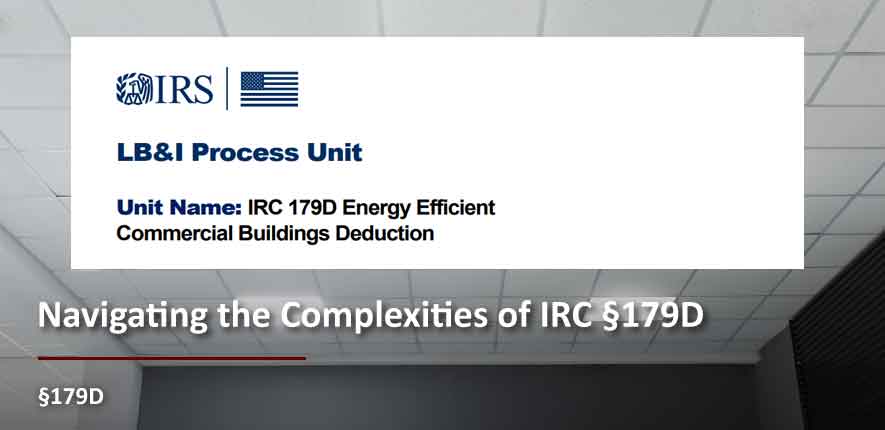
Navigating the Complexities of IRC §179D: Why Expert Guidance is Essential
The IRS has updated its Practice Unit on the §179D Energy Efficient Commercial Buildings Deduction. While not official guidance, these units provide valuable insights into IRS audit and enforcement approaches. The latest §179D updates introduce new eligibility rules, compliance requirements, and higher deduction limits. Given the complexity of these provisions...

Tax Court Case: Lighting Contractor Failed to Meet Definition of “Designer”, Denied §179D Energy Efficient Commercial Building Property Deduction
In a 2024 case, United States of America v. Oehler et al, the tax court denied the Energy Efficient Commercial Building Deduction under IRC §179D to a lighting contractor for work they performed upon public schools since it failed to meet the definition of a “designer”...

IRS Released Final Regulations for Satisfying Prevailing Wage and Apprenticeship Requirements for Green Tax Incentives
The IRS released final regulations and related guidance regarding bonus credits and deductions for taxpayers that satisfy prevailing wage and apprenticeship (PWA) requirements. The regulations apply to certain “green” energy tax provisions, such as the §179D Energy Efficient Commercial Building Deduction and the §45L Energy Efficient Home Credit, as well...

§179D Energy Efficient Commercial Building Deduction Future Reference Standards
The IRS recently released Announcement 2024-24, notifying taxpayers that Reference Standard 90.1-2022 is the applicable reference standard required under the §179D Energy Efficient Commercial Building Deduction for ‘Energy Efficient Commercial Building Property’ (EECBP) placed in service after December 31, 2028, and the construction of which did not begin by December...