
Post

ICS identified over $70,000 in Federal and state R&D credits for Oertel Architects in Saint Paul, Minnesota. The Research & Development (R&D) tax credit is a federal and state incentive available to architecture firms for technical design activities that involve resolving engineering or performance uncertainty...

The IRS has recently introduced Form 7220, Prevailing Wage and Apprenticeship (PWA) Verification and Corrections, to report compliance with PWA requirements for claiming increased tax credits or deductions. This form is important because it verifies adherence to PWA rules, enabling taxpayers to access significantly boosted incentives, such as the fivefold increase in the §179D deduction or the full 30% §48E credit on projects over 1MW, potentially adding millions in tax savings for qualifying projects....

ICS Tax is pleased to welcome Kevin Font as our newest Cost Segregation Manager. Kevin brings extensive experience in cost segregation and project management, having previously held roles at Big Four accounting firms. Kevin earned his degree from Louisiana State University’s College of Engineering, where he studied Civil Engineering and Construction Management. We are excited to have Kevin join the ICS Tax team and look forward to the value he will deliver to our clients nationwide. Outside of work, Kevin enjoys spending time with his two daughters, playing basketball, and cheering on LSU, the Saints, and the Pelicans....

The One Big Beautiful Bill Act (OBBBA), enacted July 4, 2025, significantly reshapes real estate tax planning by accelerating deductions while narrowing energy incentives. The Act permanently restores 100% bonus depreciation under §168(k), allowing immediate expensing of qualified property, including assets identified through cost segregation studies. New §168(n) enables full expensing of qualifying portions of newly constructed nonresidential buildings used in manufacturing and production, creating major benefits for industrial and logistics projects. OBBBA also permanently restructures the Opportunity Zone program with rolling 10‑year designation cycles and enhanced rural incentives, including a 30% basis step‑up through Qualified Rural Opportunity Funds. §179 expensing limits increase to $2.5 million, further supporting capital investment. At the same time, OBBBA accelerates the sunset of key energy credits, making careful timing and proactive planning between 2025 and 2031 essential to maximize tax benefits and after‑tax cash flow....

IRS Notice 2026‑16 provides long‑awaited guidance on Qualified Production Property (QPP), allowing eligible manufacturers to claim up to 100% bonus depreciation on qualifying production facilities. The guidance clarifies what buildings and activities qualify, outlines election and timing requirements, and explains how QPP interacts with cost segregation. For manufacturers expanding or reshoring U.S. operations, QPP can significantly accelerate depreciation and reduce the after‑tax cost of new facilities....

The §179D Energy Efficient Commercial Buildings Deduction has been adjusted for inflation in 2026, offering enhanced tax incentives for energy-efficient new construction as well as retrofits. To qualify, construction of a significant nature must begin before June 30, 2026, but there is no deadline for construction to be completed....

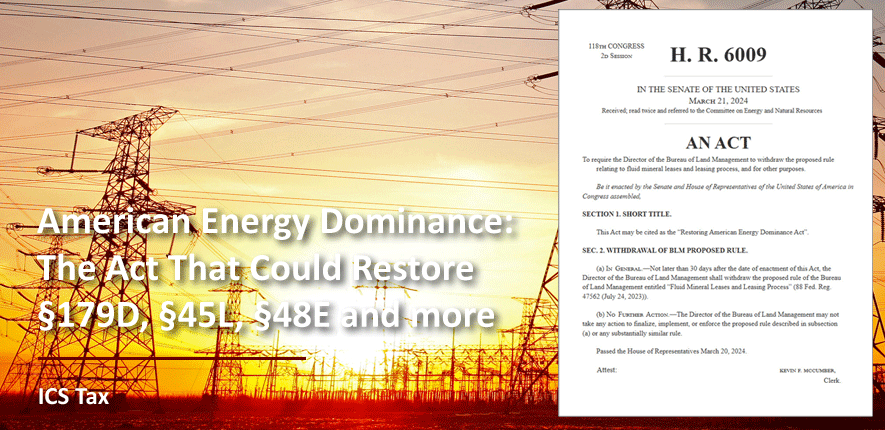
The Inflation Reduction Act of 2022 introduced powerful energy-related tax incentives under Sections 179D, 45L, and 48E of the Internal Revenue Code. These provisions provide additional rewards for projects that meet prevailing wage and, in some instances, apprenticeship requirements. They offer substantial financial benefits for energy-efficient construction, multifamily residential development, and renewable energy installations....

The One Big Beautiful Bill Act (OBBBA) introduced Qualified Production Property (QPP), a new category of real estate eligible for 100% bonus depreciation under IRC §168(n). QPP refers to nonresidential real property that is constructed or acquired after January 19, 2025, placed in service before January 1, 2031, and used directly in a qualified production activity....

The One Big Beautiful Bill Act of 2025 (OBBBA) marks a major overhaul of federal tax policy, terminating or reshaping several high-impact incentives related to real estate, clean energy, and business investment. The legislation ends the §45L Energy Efficient Home Credit for homes sold or leased after June 30, 2026, and phases out the §45X Advanced Manufacturing Credit for wind components and certain critical minerals. It also accelerates the phaseout of the §48E Clean Electricity Investment Tax Credit, establishing hard cutoffs for project eligibility....

The §45L Energy Efficient Home Credit is set to expire for homes sold or leased after June 30, 2026, as mandated by the One Big Beautiful Bill Act of 2025. To qualify, units must be certified and sold or leased by that date. Current credit amounts include $2,500 per unit for single-family homes certified as ENERGY STAR, and $5,000 per unit for those certified under the DOE Zero Energy Ready Home (ZERH) program. Manufactured homes meeting ENERGY STAR or ZERH standards qualify for the same respective credit amounts. For multifamily buildings built after 2020, the credit is $500 per ENERGY STAR-certified unit, or $2,500 per unit if prevailing wage requirements are met. ZERH-certified multifamily units are eligible for $1,000 each, or $5,000 per unit with prevailing wage. For homes sold or leased prior to 2020, the credit amounts are $2,000 per unit for new energy-efficient homes and $1,000 per unit for manufactured homes. With the expiration date approaching, developers should act now to secure these valuable credits....